I’ve been trying to put down in writing what it has been like living in Minnesota for the past two months, but it’s been hard. How do you fully capture both the pride and love you feel for your neighbors and community, and the anxiety and fear you’ve felt for your loved ones every time they leave the house?
I’ll back up by saying that as someone who has lived in the Twin Cities (both Minneapolis and St. Paul) now for the past 13 years, I am not surprised by how people have stood up against the federal immigration occupation that’s consumed our state and continue to resist in creative, non-violent ways. I’ve come to know the Twin Cities as a place of stark inequality but also a place where people care deeply for each other and aren’t afraid to show up for vigils or protest in sub-zero temps. Some days though, the fear has been paralyzing.
So, what are things like right now? For me, things generally feel quieter than they were a few weeks ago, or certainly a month ago. We don’t drive around our neighborhood daily on edge, waiting to see an ‘out of state’ license plate that could be ICE, sending messages to neighbors over our Signal chat thread. Still, too many people are living in fear, hiding in their homes, and have been for weeks, even months. Still, people are being kidnapped by ICE. Still, the trauma of federal occupation lingers.
Some family and friends have asked me, “How is this happening in MN?” or “How is this happening in our country?“. So much of what has happened these past few months has felt disjointed, out of a science fiction dystopian novel.
Yet, when I’ve paused to think about it more, I’m reminded that Black and Indigenous people have experienced violence and inhumane treatment from the federal government and law enforcement for centuries in this country. Now, it’s just affecting a larger portion of the population, and has come into our social consciousness. We can’t forget our own U.S. history of broken treaties and boarding schools, enslavement and plantations, and Jim Crow.
As I’ve been reflecting on who we are as a nation, I remembered a podcast I listened to this past fall by Ameya Desai, a 5th grader, who won NPR’s student podcast challenge. Ameya interviewed a survivor of the Japanese American “internment”, or incarceration camps, Linda Horikawa, in a podcast titled “Far From Home – Shikata Ga Nai”.

From this podcast interview with Linda, what strikes me the most is the forced removal of 120,000 (roughly) Japanese Americans by the the federal government isn’t some far off history. Survivors and their families are still impacted to this day. When Linda Horikawa was asked about this podcast interview she shared, “I am honored. It means that another story will not be lost in time, another story that may help people not repeat the same mistakes.”
The novel “Our Missing Hearts” by Celeste Ng stands out in my mind as a novel that reflects our current reality, too. In this novel, the protagonist is a young adolescent living in the U.S. and witnesses other young people his age being taken by the federal government and ‘disappearing.’ The author Celeste Ng shares in a Time article titled “Celeste Ng did not set out to write this book” that “I don’t pretend to have the answers. But every book I’ve written is me trying to tell you what I see in the world. Not how the world is—just what I see.” So often children are used as a tool of social control by authoritarian governments, and ours right now, is no different.
Ten years ago, I taught in Columbia Heights, at the middle school and substitute taught at 3 of their elementary schools, including Valley View Elementary. Columbia Heights is a small, incredibly diverse, inner ring suburb that I know well. I love this place and adored the students I worked with there. Columbia Heights Schools has had dozens of students and their parents taken by federal immigration agents.
In this incredibly well done video by the New York Times, Columbia Heights students tell their stories. In the interviews, students write letters and poems addressed to ICE agents and to one of their classmates taken by ICE, Liam Conejo Ramos. Their words are both powerful and heartbreaking.
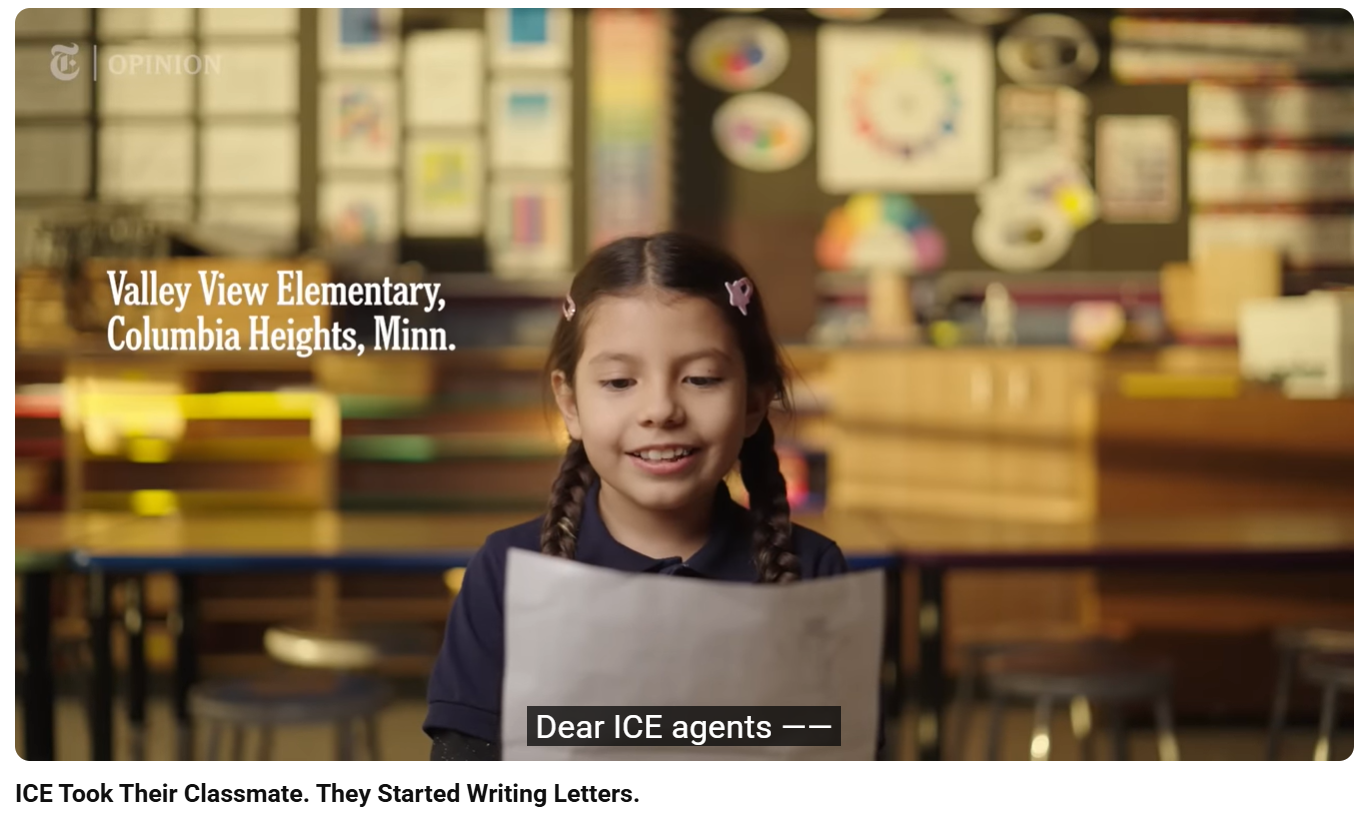
How have we been surviving right now? I cannot tell you, but we are. We just keep going. We don’t have any other choice.
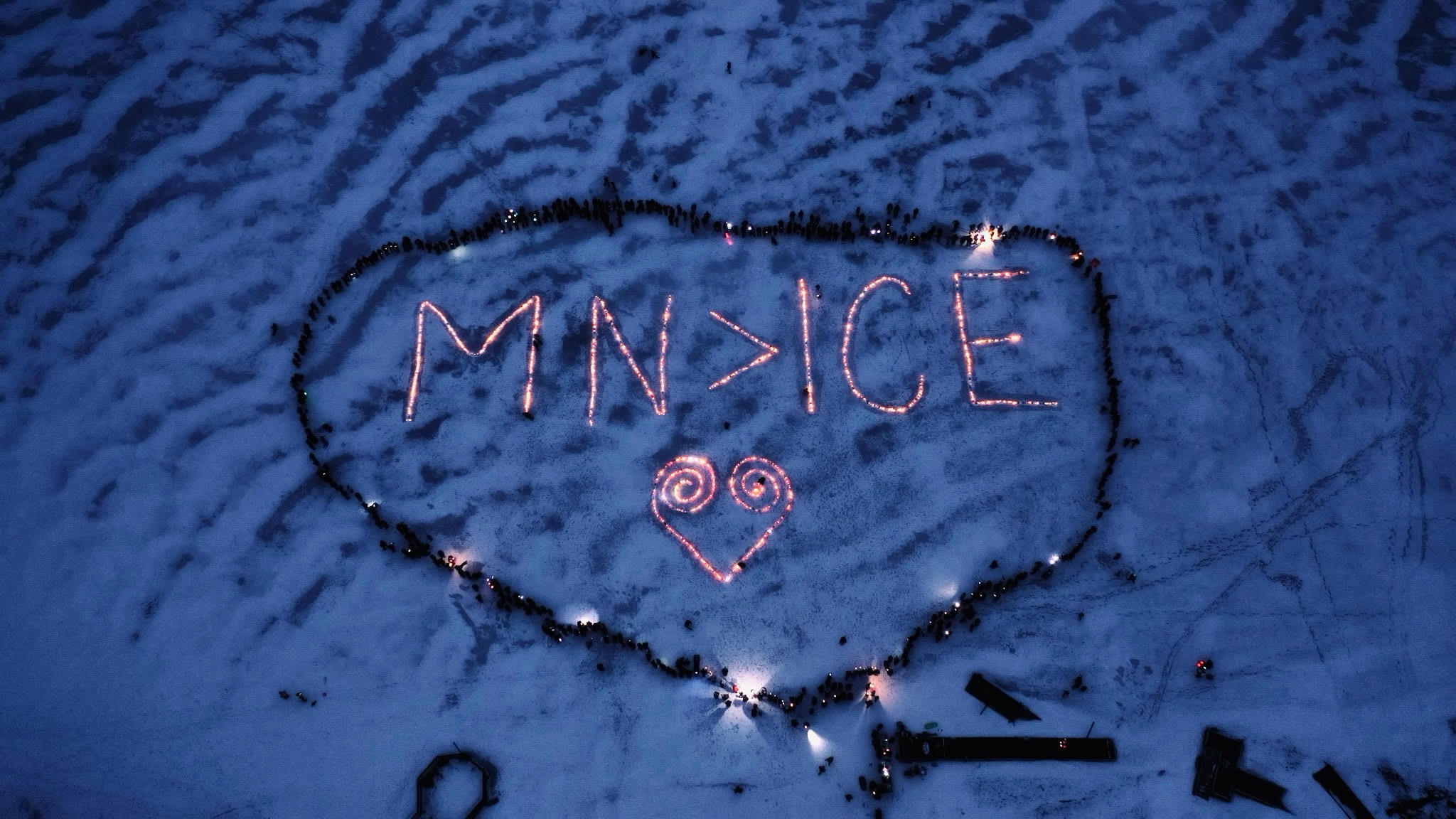
Earlier last month, on a cold, windy Saturday night in the single digits we joined hundreds of neighbors and Eastside community members at Lake Phalen. We didn’t fully know what to expect when we arrived except there would be a candlelight vigil and the promise of snacks and community.
Here’s a bit of what we saw: people eating pizza and drinking chai tea made by volunteers, a long table filled with people prepping candles in bags, kids holding ‘ICE Out’ signs and walking around with hot chocolate.
The warmth of being around so many people there for a common reason, to show the strength of our community and solidarity of neighbors standing together, filled me with pride and hope. A few of the organizers had us stand side by side and starting leading us in songs. We sang and watched the candle design being placed on the ice. Despite the wind whipping, and our long walk back to our car afterwards, I left feeling warm and hopeful for the first time in weeks.
The beauty amidst the horrors of the immigration enforcement actions has been getting to know our neighbors. I never expected to get to know my neighbors who we’ve lived next to the past five years so quickly in the span of just a few months. We’ve started group chats, joined neighbors for dinner to support local restaurants, and gathered at local congregations for neighbor-led community meetings. It feels good to be reminded that we aren’t alone in this, and we’ll get through this together.
Here’s a few podcasts I’ve been enjoying that I encourage you to check out:
- Stacey Abram’s podcast “Assembly Required”
- Samantha Bee’s podcast “Choice Words”
- Poetry Unbound podcast with Padraig O Tuama
And, a few organizations to check out if you’re able to donate your time or resources:
- Casa Maria Food Shelf
- Immigrant Law Center of MN
- MN8
- CAIR MN
- The Advocates for Human Rights
- The Bond Between
I’ll leave you with this: It may have started with Minnesota fighting back, but it won’t end with us.
It can’t end with us.
May each of us find small ways to resist.
 Seeds of Hope